AI for Sales Leaders
How Sales Managers Should Coach an AI-Assisted Discovery Recap
SimplSolutions Editorial Team · 8 min read
Published
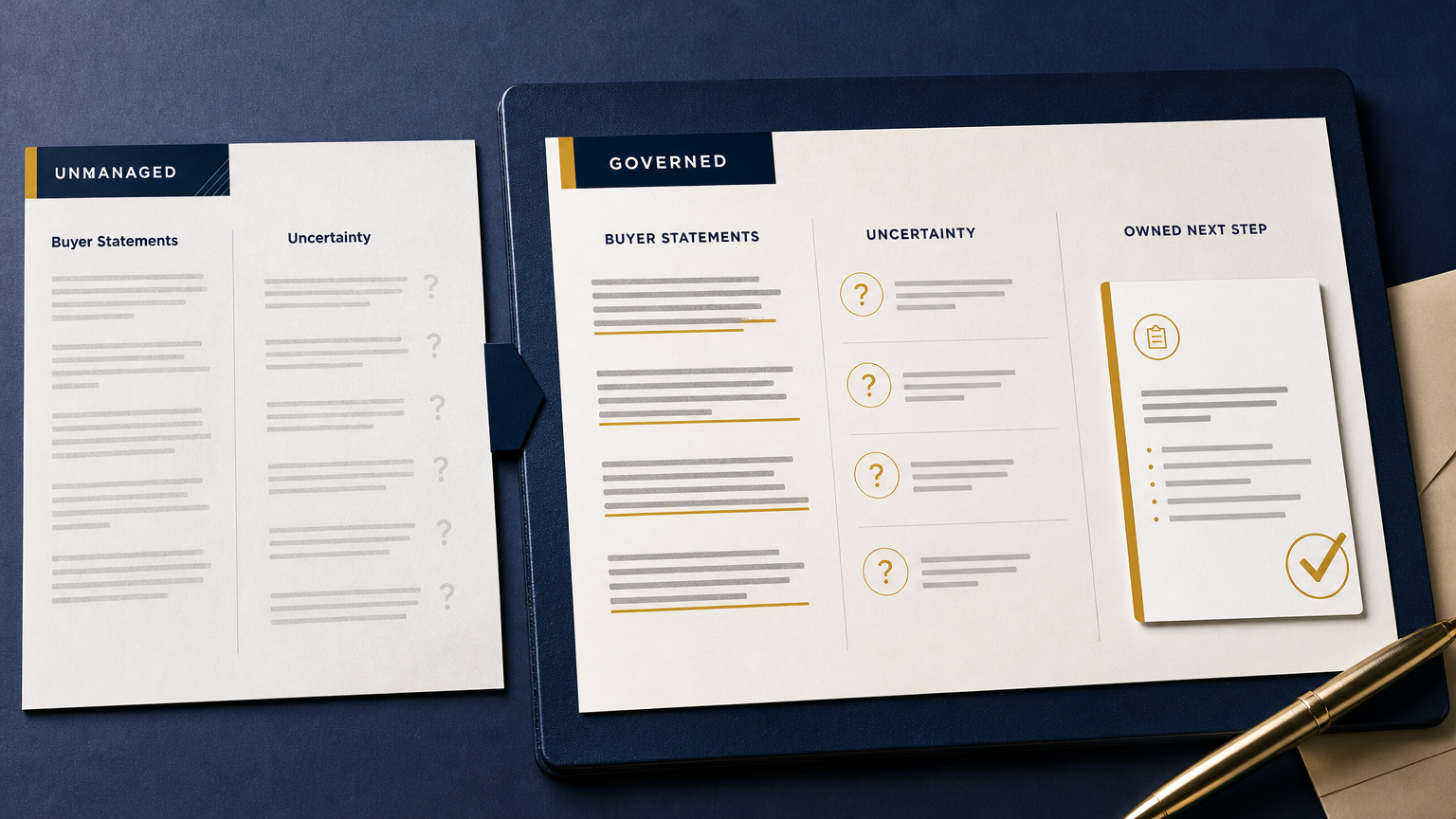
The risk is not that the recap sounds wrong
The more common risk is that it sounds reasonable.
An AI-generated discovery recap may turn a partial conversation into a polished account of the buyer’s needs. A concern can become a priority. A possibility can become a requirement. A seller’s proposed next step can appear to be a buyer commitment.
Once that language reaches the CRM, it can influence forecast discussions, account strategy, manager coaching, and follow-up. The issue is not whether AI can produce fluent notes. The issue is whether the record distinguishes evidence from interpretation.
The principle is simple: a recap should help the team remember what happened without pretending to know more than the conversation established.
The four checks before approval
A manager does not need to rewrite every sentence. A focused review can ask four questions.
1. What did the buyer explicitly say?
Look for statements attributable to the buyer, not conclusions written on the buyer’s behalf.
Useful evidence might include:
- A stated operational problem
- A described consequence or business impact
- A named process, team, or system involved
- A timeline the buyer actually gave
- A stated evaluation question or concern
Be careful with language such as “the buyer needs,” “the account is ready,” or “the customer agreed.” Those phrases may be accurate, but only if the conversation supports them.
A practical coaching question is: “Which sentence in the conversation supports this statement?” If the seller cannot point to one, the recap should qualify or remove it.
2. What remains uncertain?
A good recap does not hide gaps to appear complete. It makes them visible.
Common gaps include:
- The size or frequency of the problem
- Whether the issue is a priority now
- Who else is involved in the decision
- The buyer’s evaluation criteria
- Budget, timing, or approval process
- Whether the buyer accepted the proposed next step
Uncertainty should be written as an open question, not buried in confident prose. For example: “The team may be experiencing delayed handoffs; impact and frequency were not confirmed” is more useful than “The team has a significant handoff problem.”
The distinction matters for coaching. The seller is not being penalized for an unanswered question. They are being coached to notice it and create a responsible path to answer it.
3. Which business problem is actually evidenced?
Discovery conversations often contain several threads. A manager should separate the problem the buyer described from adjacent problems the seller believes the offering could address.
Ask:
- What problem did the buyer describe in their own context?
- What consequence did the buyer connect to it?
- Is the consequence observed, estimated, or assumed?
- Is this a business problem, a symptom, or a proposed solution?
- What evidence would change our confidence?
This review prevents solution language from replacing discovery. “The buyer needs better forecasting” may be a seller interpretation. “The sales operations lead said forecast updates require manual consolidation across teams” is a more bounded account of what was discussed. The former may eventually be true; the latter identifies the evidence available now.
4. Who owns the next step?
A next step is not confirmed merely because the recap includes one.
The manager should verify:
- What action is being proposed?
- Who agreed to do it?
- By when, if a date was actually established?
- What question or decision will the action address?
- What remains dependent on buyer confirmation?
Ownership should be explicit. “Seller to send a summary and ask whether the operations lead should join a follow-up” is different from “Buyer agreed to a technical evaluation.” The first is a seller-owned action. The second requires evidence of buyer agreement.
If no next step was agreed, the recap should say so. The seller can still propose a follow-up, but the proposal should not be recorded as a commitment.
Worked example: plausible recap versus approved recap
The following example is illustrative. It is not a report of a real customer conversation.
A plausible but overconfident recap
The buyer is struggling with inconsistent forecast updates across regional teams, which is creating a significant visibility problem for leadership. They need a more reliable process and agreed to bring sales operations into a technical evaluation next week. The account is actively evaluating solutions and is likely to move forward this quarter.
This version is fluent, but several claims outrun the evidence. It treats a possible issue as an established business problem, labels the impact as significant without support, converts a suggested participant into an agreed attendee, and adds purchase intent and timing that may not have been discussed.
A manager-approved version
Buyer-stated: The regional sales manager said forecast updates are currently consolidated manually and that leadership does not always receive updates at the same time. The buyer described this as frustrating but did not quantify the business impact.
Uncertain: It is not yet confirmed whether inconsistent timing affects forecast accuracy, leadership decisions, or close planning. The buyer’s evaluation process, budget, and target timeline were not discussed.
Evidenced problem: Manual consolidation and inconsistent update timing are the clearest operational issues described in the conversation. A broader forecasting or revenue-impact problem remains a hypothesis.
Next step: Seller owns sending a short written recap that asks the buyer to confirm the impact, current process, and whether a sales operations stakeholder should join a follow-up. No buyer commitment to a meeting or evaluation was confirmed.
The approved version is not weaker. It is more useful because it preserves the buyer’s words, marks the limits of the evidence, and gives the seller a concrete way to improve the next conversation.
Coach the gap, not just the wording
When a recap is overconfident, a manager should avoid making the coaching lesson “write more cautiously.” That can produce timid notes without improving discovery.
Instead, connect each gap to a behavior:
- Unsupported impact: Coach the seller to ask how the issue affects decisions, time, cost, risk, or customer experience—and to record the answer at the buyer’s level of certainty.
- Unclear priority: Coach the seller to ask what makes the issue important now, if anything.
- Missing stakeholders: Coach the seller to ask who owns the affected process and who would evaluate a change.
- Unconfirmed timing: Coach the seller to distinguish a buyer’s deadline from a seller’s preferred sales cycle.
- Unowned follow-up: Coach the seller to end the conversation with a mutually understood action, or to label the next outreach as a proposal.
A useful manager prompt is: “What do we know, what do we think, and what will we ask next?” That three-part distinction can become a consistent review habit without turning every recap into a lengthy approval process.
Keep CRM data proportional to evidence
The CRM should not become a storage system for polished guesses. Managers can establish a proportionality rule: the stronger the downstream consequence of a field, the stronger the evidence required before approval.
For example, a free-text conversation summary may include a clearly labeled hypothesis. A forecast category, committed date, buying-stage change, or customer-agreed action may require direct confirmation. The exact controls will depend on the organization’s process, but the principle is stable: do not let a confident sentence silently become a consequential record.
This is also where review design matters. A manager might require the seller to identify evidence for material claims, mark unresolved questions, and confirm action ownership before a recap can shape forecast or follow-up. That is a governance choice, not a claim that every AI-generated note requires the same level of review.
A voluntary governance lens from NIST
The NIST AI Risk Management Framework is intended for voluntary use and is designed to help organizations manage risks associated with artificial intelligence while considering trustworthiness in the design, development, use, and evaluation of AI systems.
For sales leaders, its value here is as a governance lens rather than a sales-specific rulebook. A manager can apply the underlying discipline by asking:
- What could go wrong if an inferred claim is treated as fact?
- Who is responsible for reviewing the recap?
- How will the team identify and correct errors?
- What evidence is retained for consequential updates?
- When should the system defer to human judgment?
NIST is not prescribing a particular CRM workflow in the source provided, and the framework is not presented here as a sales regulation. It offers context for treating AI-assisted records as reviewable outputs rather than unquestioned truth.
A practical manager review standard
Before approving an AI-assisted discovery recap, look for four labels or answers:
- Explicit: What did the buyer actually say?
- Uncertain: What is still unknown or only inferred?
- Evidenced problem: Which business issue is supported by the conversation?
- Ownership: Who will take the next action, and was it agreed or merely proposed?
If one of these is missing, the right response is usually not to discard the recap. Ask the seller to narrow the claim, label the uncertainty, or create a follow-up that resolves the gap.
That is the manager’s role in an AI-assisted discovery process: not to approve fluent text, but to protect the quality of the evidence and coach the next human conversation.
The next step for sales leaders
Review a small sample of recent AI-assisted discovery recaps with your managers and sellers. Mark each statement as buyer-stated, inferred, unresolved, or action-related. Then agree on what evidence is required before a recap can influence CRM fields, forecast discussions, or follow-up ownership. This creates a shared standard without assuming that automation can replace judgment.